From Jujutsu Roots to Brazilian Jiu-Jitsu
Trace how Brazilian jiu-jitsu developed from Japanese jujutsu through migration, teaching and local adaptation, while distinguishing shared context from disputed claims.
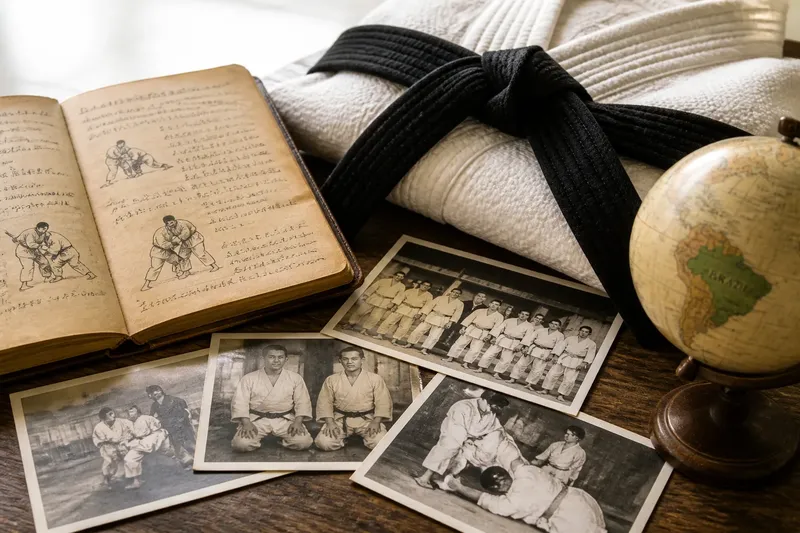
The most common mistake in telling Brazilian jiu-jitsu history is to credit its emergence to one person or one decisive encounter. That shortcut obscures the longer process: Japanese martial instruction reached Brazil, and teachers and students there shaped a distinct practice over time.
Brazilian jiu-jitsu developed through transmission and change
Brazilian jiu-jitsu, often shortened to BJJ, has roots in Japanese jujutsu traditions. Jujutsu was not one uniform system with a single curriculum; the name covered varied schools and methods. The spelling “jiu-jitsu” reflects an older English-language rendering of Japanese terms, and usage has varied across periods and communities.
It is more accurate to describe BJJ as an evolving inheritance than as either an unchanged copy or a wholly separate invention. Teachers carried methods into new settings, students learned and adapted them, and local communities decided what to preserve. Over time, those choices formed a recognizable practice without erasing its ancestry.
Migration and teaching connected Japan and Brazil
Japanese migration to Brazil created communities through which cultural knowledge could travel. Martial arts instruction was one part of a broader history of movement, work, family life and exchange. Instructors and students helped carry practices between countries, though the surviving accounts do not always agree about who taught whom or when particular methods entered a school or family.
For a historical account, it helps to distinguish the broad pattern from the details. Japanese martial instruction took root in Brazil; claims about exact sequences, firsts or exclusive credit require closer attention to the sources behind them.
Brazilian schools gave the practice distinct emphases
Teachers and students in Brazil developed approaches to grappling and instruction that came to be associated with sustained ground fighting, positional control and submissions. These features help explain how many people recognize BJJ, but they do not establish that one individual created the entire art.
Schools and families preserved particular approaches and passed them on through teaching. Their lineages shaped vocabulary, training customs and ideas about effective learning. Different groups could emphasize different parts of the practice, so a family’s account may describe its own influence without settling the history of every branch.
Say a student hears that an academy descends from a particular family line. The student asks who taught whom, what records or community accounts support the link, and whether the claim describes an influence or an unbroken chain. The resulting answer clarifies what the lineage claim means without requiring the student to dismiss other accounts.
Competition made the art more visible
Organized matches gave practitioners a shared setting in which to compare approaches under stated rules. Public contests also encouraged schools to explain how their art differed from other martial practices. Competition helped make BJJ recognizable beyond its teaching networks, but it did not create the practice from nothing.
A match can show how a particular practitioner acted within a particular rule set. It cannot, on its own, establish the full history of a tradition. Migration, instruction, family organizations and ordinary training also shaped the art’s development.
Sources and claims need to be read at the right scale
Accounts of BJJ’s early history may draw on family recollections, school histories and institutional records. These sources can preserve valuable information, but they may emphasize different people or define the art’s beginning differently. A reader should ask what each account actually supports rather than treating every disagreement as a conflict over the entire history.
- Broad historical context: BJJ developed in Brazil from Japanese jujutsu traditions through migration and instruction. If an account addresses this general process, treat it as background; if it makes a precise claim about priority, look for specific supporting records.
- A teacher’s influence: A person may have shaped a school or lineage. If the account names students and a teaching relationship, read it as a claim about that network; if it extends the claim to all of BJJ, seek evidence beyond the school’s own history.
- A family tradition: A family may preserve a meaningful account of its development. If it identifies the people and scope involved, understand it as that family’s record; if it claims exclusive credit, compare it with other accounts.
- An early encounter: Recollections may differ on the timing or circumstances. If a source provides contemporaneous documentation, weigh that material for the specific event; if it relies on later memory, note the uncertainty rather than treating detail as settled.
- A competition story: A match can illustrate practice under particular rules. If the claim concerns that event, keep the conclusion within its rules and participants; if it is used to prove the origin of the art, look for historical evidence about teaching and transmission.
- A lineage claim: A school may describe how its instruction connects to earlier teachers. If it explains the links and the meaning of “lineage,” the claim is easier to assess; if it offers only a broad label, ask for clarification before drawing a conclusion.
These distinctions help readers respect a community’s history while avoiding the assumption that one institution’s account must speak for every branch.
What questions clarify Brazilian jiu-jitsu history?
Was Brazilian jiu-jitsu simply Japanese jujutsu under another name?
No. Japanese jujutsu provided an important inheritance, while teachers and communities in Brazil developed a practice with its own emphases and identity. Continuity and change can both be part of the story.
Can one person be credited with creating BJJ?
A person can be central to a particular lineage or historical account, but the broader emergence involved teachers, students and communities over time. A single-founder account compresses that wider process.
Why do accounts of the early history disagree?
Family memories, school histories and institutional records may emphasize different people or use different definitions of the art’s beginning. Disagreement about exact credit does not erase the shared context of Japanese roots and Brazilian development.
What does a lineage claim tell a student?
It describes a teaching connection and the history a school chooses to preserve. Its significance depends on how specifically the school explains the link and what records or community accounts it cites.
Adaptation is central to BJJ’s history
Brazilian jiu-jitsu history is not a clean transfer of an unchanged system. It is a story of martial practices moving through people, followed by local teaching, selection and reinterpretation. The broad path is clearer than every claim about exact priority or individual credit.
When reading Brazilian jiu-jitsu history, separate ancestry, a family’s lineage and a claim of sole invention. Those are different kinds of statements and call for different evidence. Keeping the distinctions clear makes room for both the art’s Japanese roots and the work of the Brazilian communities that shaped it.