Gi or No-Gi: What Changes in the Training Room?
Gi or no-gi training changes grips, laundry, and gear choices; understand those differences before packing so your first class feels familiar.

The most common mistake when comparing gi or no-gi training is to treat clothing as a uniform choice and nothing more. In practice, it changes the grips available, the equipment that belongs in your bag, and the texture of shared movement. Knowing those differences helps you arrive prepared without assuming one format is better.
Gi or no-gi changes what the hands can hold
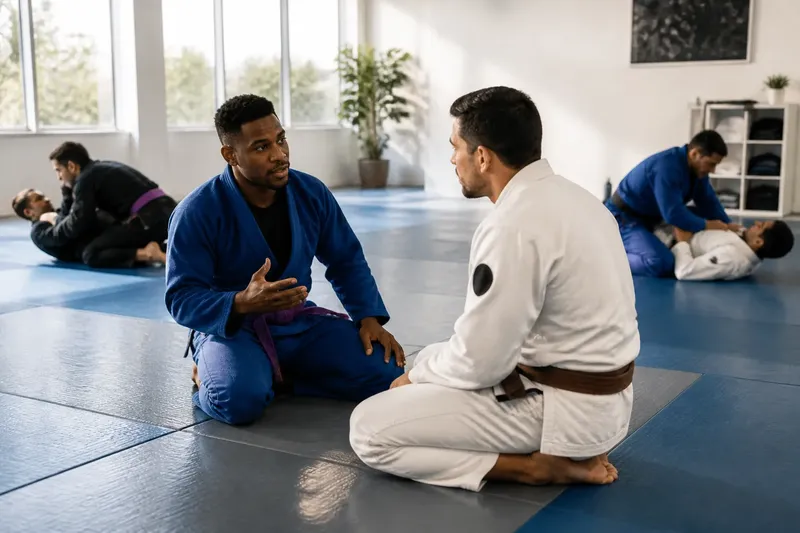
In gi practice, the jacket and pants become part of the contact between partners. A lapel, sleeve, or trouser cuff can be held, so movements may involve keeping or clearing fabric grips. The gi adds material to manage; it does not make the clothing itself a substitute for balance, timing, or cooperation.
No-gi practice removes those fabric grips. People generally wear a rash guard with grappling shorts or leggings, and contact is made through the body rather than a uniform. The absence of cloth changes what a hand can hold and how a partner feels under pressure. It also means that a gi-specific grip cannot simply be carried over unchanged.
These differences are easiest to understand as a change in available contact points, not as a ranking of difficulty. A newcomer may find the gi’s handles reassuring at first, or may prefer the simpler clothing of no-gi. Either impression can change with familiarity.
A hypothetical newcomer learns by packing for both
Say Maya, an invented beginner, has been invited to a gym that offers both formats. She owns a basic gi from a prior introduction to grappling but has never attended a no-gi class. Her immediate question is not which style to choose forever; it is what to bring to each session and what kind of contact to expect.
For the gi class, Maya packs a clean gi, a belt if the academy uses one, and a change of clothes. She checks that the jacket closes comfortably and that the cuffs do not hang loose. For the no-gi class, she sets aside a rash guard and fitted grappling shorts without pockets, zippers, or hard trim. She also brings a towel and water bottle for either session.
At the first class, Maya notices that partners take holds on her sleeves and lapel. She learns that the cloth can bunch or pull, so a well-fitting, intact gi matters to both people. At no-gi, she notices there is no jacket to grasp; contact feels more direct, and her rash guard helps keep the interaction covered and comfortable. She leaves with a practical result: two distinct packing routines, rather than a verdict about which room suits her.
The useful lesson from Maya’s situation is that clothing affects the whole training experience in small, repeated ways. It shapes where hands go, what needs washing, and whether a garment stays in place during movement. Those details are more informative than trying to settle the comparison in advance.
Each format calls for a different equipment check
A gi is usually a jacket, pants, and belt, though academy customs vary. Look for sturdy seams, secure closures, and sleeves and pants that allow movement without excess fabric. A gi should be clean and dry before class. A torn seam or loose, damaged garment can snag or distract, so repair or replace it rather than bringing it onto a shared mat.
No-gi clothing is usually lighter. A rash guard covers the torso, while grappling shorts or leggings should stay secure without restrictive fasteners. Pockets and exposed zippers are commonly avoided because they can catch a finger or scrape a partner. Some schools specify shirt styles or require particular shorts, so a newcomer should ask before buying specialized gear.
For either format, nail care, clean clothing, and a way to carry damp gear matter. A separate laundry bag keeps sweaty items away from clean clothes on the trip home. Wash training clothes after class and let them dry fully before packing them again. Do not leave a damp gi folded in a closed gym bag.
- Before a gi class: Check the jacket, pants, belt, and seams for fit, cleanliness, and damage.
- Before a no-gi class: Check that the rash guard and shorts or leggings stay covered and have no hard or loose parts.
- For either class: Bring water, a towel, and a separate bag for used clothing.
- Before buying: Ask the academy about its dress rules and any required uniform details.
- After training: Wash the clothing and dry it fully before storing it with clean gear.
What should you expect from the feel of practice?
Does a gi make movement feel slower?
Fabric creates more places to grip and more material to handle, which can make exchanges feel deliberate or intricate. That sensation depends on the partners, the pace, and the school’s training customs; it is not a fixed measure of how demanding a class will be.
Does no-gi require different clothing?
Usually, yes: fitted athletic clothing replaces the gi jacket and pants. A rash guard and grappling shorts or leggings are common choices, but the academy’s rules determine what is acceptable in its room.
Can the same person attend both formats?
Many academies schedule both, and a student may choose to attend each when the timetable and membership allow. The clothing and grip possibilities differ, so expect to learn the room’s conventions rather than assume the sessions will feel identical.
Do I need to buy a gi before trying a class?
Not always. Some schools lend uniforms or offer an introductory session with specific clothing guidance. Ask the academy before purchasing, especially if you are unsure about its uniform requirements.
Comfort and care belong to the comparison
A gi can feel heavier and warmer because it has more fabric. No-gi clothing tends to sit closer to the body, which some people find less cumbersome. Neither description predicts what a particular person will prefer. Room temperature, fabric, fit, and the pace of a class all contribute to comfort.
Shared practice also makes cleanliness a matter of consideration for partners. Wear freshly washed clothing, keep nails trimmed, and avoid training in gear with sharp edges, loose closures, or damaged fabric. If a garment becomes uncomfortable or shifts out of place, pause and adjust it rather than ignoring the distraction.
For clothing details, follow the academy’s rules and the garment maker’s care label; local requirements may also apply to organized events. That small check can prevent an avoidable purchase or a surprise at the door.
Choose a first session by the room, not a ranking
If both classes are available, visit the one that fits your schedule and ask what to wear. Notice how the instructor explains clothing expectations, how partners handle grips, and whether the pace feels manageable for a newcomer. Those observations tell you more about your fit with a particular class than broad claims about gi or no-gi.
Some students enjoy the fabric grips and uniform customs of gi practice. Others prefer the lighter clothing and direct contact of no-gi. It is also reasonable to attend both and let experience clarify what you like. The right choice may be the class you can reach consistently, with gear that fits and a room where expectations are clear.
Before your next Brazilian jiu-jitsu session, use the phrase gi or no-gi as a practical packing question: which clothing does this class require, and what will it let partners hold? Answer that, care for the gear, and the format can be experienced on its own terms.