The Myth of the Perfect Training Partner
A useful Brazilian jiu-jitsu training partner need not fit one ideal. Learn how to choose rounds by goals, communication, pace, and shared limits.
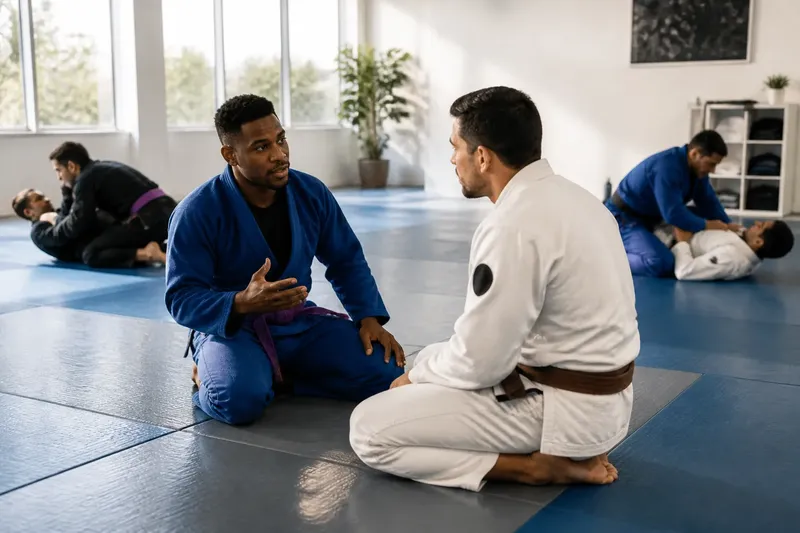
The common mistake in choosing a Brazilian jiu-jitsu training partner is waiting for one ideal person: similar in size, experience, pace, and temperament. That expectation can shrink the room you are willing to learn in, and it can turn ordinary differences into reasons to avoid useful rounds. A better measure is whether both people can communicate, adjust, and share the work.
Partners do influence a round. A large difference in strength, an unfamiliar pace, or uncertainty about a partner’s intentions can change what feels manageable. But no single profile fits every purpose. Think of a partner as a fit for a particular kind of practice, not as a permanent verdict on whether someone is good to train with.
Choose a partner by the kind of round you need
Before pairing up, identify what you want from the round. That does not mean scripting every movement. It means knowing whether you are looking for a calm return to familiar positions, a chance to work with varied reactions, or a round in which you and your partner explore a shared question.
- If you are returning after time away: Ask someone who can keep the pace conversational and pause when either of you needs to clarify something. The useful quality here is responsiveness, not a particular belt rank or body type.
- If you are learning a new position: A partner who can offer a clear, measured response may help you notice what is happening. Agree on a narrow starting situation, then decide together when to broaden the exchange.
- If your practice feels too familiar: Consider a partner with a different movement style or experience level, provided you can agree on a pace that suits both of you. The difference can make your usual habits easier to notice.
- If you are tired, unsettled, or managing a limitation: Choose someone you trust to respect a lower-intensity round, or sit out if that is the better choice. Training is shared practice, not an obligation to match someone else’s energy.
- If you want to explore an open round: Look for a partner willing to talk briefly beforehand and adjust as the round unfolds. A shared understanding matters more than an assumption that you both mean the same thing by “normal.”
These are starting points, not categories people must stay in. A person who is excellent for a technical discussion may not be the right fit on a day when you need a quiet round. Someone whose style differs from yours may be useful when you have room to adapt, and less suitable when you need predictability.
Communication makes differences workable
Clear communication need not become a long negotiation. A short exchange can establish the broad terms: “I’m working lightly today,” “Could we start from this position?” or “I have a sore shoulder, so please avoid pressure there.” The other person can respond, suggest a different plan, or decline. All three responses help make the pairing more honest.
During the round, pay attention to what happens after you speak. Does your partner slow down when asked? Can you pause without being mocked or hurried? Do both of you seem to understand the agreed intensity? These small signs matter more than a polished promise at the start. If the answer changes, stop and reset rather than hoping the mismatch will resolve itself.
Communication also includes listening. If a partner names a boundary, treat it as part of the round rather than as a challenge to work around. If you are unsure what they mean, ask before continuing. A direct question is usually less disruptive than making a guess with someone else’s comfort or safety.
Match differences to the day, not to a fixed ideal
Partners of similar size can still have very different strength, speed, confidence, or experience. Partners of different sizes can sometimes share a useful round when the pace and intentions are clear. Size alone does not tell you how the interaction will feel, and experience alone does not tell you whether someone is attentive.
Training history matters in a more specific way. A newer student may benefit from a partner who can keep an exchange comprehensible without taking over. An experienced student may appreciate working with someone whose reactions are less familiar, but should not treat that person as a prop. Both people need a reason to be there and room to participate.
Say you have been practicing a new guard entry and want to understand how it connects to the next position. You ask a partner who has trained longer to begin from a familiar setup, respond at a controlled pace, and pause if either of you loses track of the question. The expected observable result is not a successful move; it is that both of you can tell which moment needs more attention and decide whether to repeat, change, or leave it there. The partner’s experience helps only because you have agreed how to use it.
There are also days when a mismatch is simply a mismatch. If one person wants a relaxed technical round and the other wants a hard exchange, neither has to persuade the other to compromise. Find another partner, ask the instructor for help pairing, or choose a different form of practice. Respectful refusal protects the room’s ability to stay welcoming.
Useful rounds depend on what each person can offer
A partner does not need to act as a coach to be helpful. They can give clear reactions, maintain a chosen pace, ask a question, or share what they noticed after the round. They can also say when they are uncertain. That honesty keeps a training exchange from being mistaken for instruction or treated as a performance.
Both people should have a meaningful role. If one student repeatedly dictates the pace, position, and purpose, the other may be present without really sharing the practice. Try alternating who chooses the starting situation or asking, “What would be useful for you today?” A small turn-taking habit can make the round feel more reciprocal.
At the same time, a round does not need to serve both people in precisely the same way. One person may be exploring a position while the other practices recognizing its transitions. The arrangement works when both understand the purpose and can speak up if it stops feeling worthwhile.
What should you ask before a round?
How do I ask for a lighter round?
Say plainly that you want a lighter pace, and name any boundary that matters to you. Ask your partner to confirm that the plan works for them; if it does not, choose someone else or sit out.
Should I avoid partners who are much larger or more experienced?
Not automatically. Consider the actual difference, your comfort, the kind of practice you want, and whether the other person listens and adjusts. If you cannot establish a shared pace, you do not need to take the round.
What if my partner changes the agreed intensity?
Pause the exchange and restate what you agreed to. If the pattern continues, end the round and speak with the instructor if you need help handling the situation.
Is it rude to decline a training partner?
No. You can decline briefly and without criticizing the person, then look for a better fit for that session. A courteous boundary is clearer than agreeing and hoping the round will suit you.
Use the room without expecting one perfect fit
Brazilian jiu-jitsu is practiced with other people, so learning to choose and negotiate a round belongs to mat culture as much as remembering to bow or share space. A good partner is not a fixed type. It is someone whose approach can meet the purpose of this particular exchange, with enough trust and communication for both people to adjust.
When you cannot find that fit, the answer is not to force one. Ask the instructor, change the plan, or take a break. When you can find it, treat the round as shared work: state what you need, make room for what the other person needs, and leave space to revise the agreement. That is a more useful standard than searching the room for a perfect training partner.